. |
In the Spotlight:
Population of False Killer Whales Proposed as Endangered Species
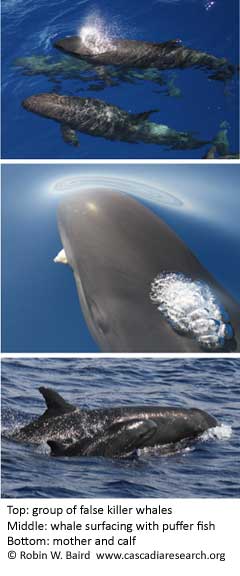
False killer whales live throughout tropical oceans of the world and while most populations prefer the open ocean, one unique group prefers the shallow waters surrounding the Hawaiian Islands. Hawaiian insular false killer whales are a fascinating population that relies on a fragile habitat, threatened by human activity. After several years of research and data collection by marine and fisheries scientists, the National Marine Fisheries Service (NMFS) recently proposed that the population of Hawaiian insular false killer whales be listed as endangered.
Scientists identify several factors that contribute to the population decline over the past 20 years. The most notable threats include small population size, fatal encounters with fishing gear, a reduction in available food, and exposure to pollutants. If listed as an endangered species, the Hawaiian insular population of false killer whales could benefit from specific guidelines and laws restricting human interference to the population's habitat and survival needs. In addition, if the present proposal to expand the boundary of the Hawaiian Islands National Marine Sanctuary is approved, the population would benefit as part of the protected ecosystem.
Scientists estimate the current Hawaiian insular false killer whale population to be approximately 151 individuals and within the population approximately 46 are breeding adults. Such small numbers of reproducing individuals limit genetic diversity. Inbreeding leads to reproductive failure and behavioral problems in future generations, presenting significant odds for the survival of the population.
Commercial fisheries are also a significant risk to Hawaiian insular false killer whales. Longline fisheries, troll, handline and other fishing methods all are known to injure or kill false killer whales when they become entangled in fishing gear. The prey of false killer whales includes many of the same species sought by commercial fisheries. This causes two problems. First, false killer whales are attracted to fishing areas and become trapped in fishing gear at a rate of about 13 whales per year (estimated for longline fisheries). Second, commercial fisheries are in direct competition for food needed by false killer whales for survival. While the number of fish taken each year for commercial fisheries has decreased compared to a decade ago, the total take has an impact on the Hawaiian insular false killer whale population.
Hawaiian insular false killer whales feed on fish and squid. Scientists know a good deal about what they eat because false killer whales bring their prey to the surface. They are intelligent predators, known to hunt in groups and share prey between individuals. Cooperative hunting is one behavior that is clearly passed from one generation to the next. False killer whales foraging at various depths; Mahi-mahi is a favored surface water fish, while bigeye tuna and swordfish typically swim deeper in the water column. As top predators, false killer whales accumulate toxins in their fatty tissues from their prey. Scientists report high levels of toxins including the Persistent Organic Pollutants (POPs), PCBs and heavy metals in false killer whales and other Hawaiian island species. These toxins are associated with significant health effects.
False killer whales are very social animals with strong bonds between individuals. They are long-living with a slow reproduction rate, one calf every 6-7 years beginning when females are about 10. While the species name is similar to the well-known Orca killer whale, false killer whales share only similar skull and teeth structure, and do not resemble killer whales in external appearance.
Scientists are able to study the behavior and movement of false killer whales by observing them in their habitat and by deploying satellite tags which allow tracking of individual animals each time they surface. Recent movements of the Hawaiian insular population of false killer whales, currently being considered for endangered status, are tracked by Dr. Baird of Cascadia Research Collective.
Check out the tracks on the maps and data page and consult the Cascadia Research Collective webpage for further information about this interesting species.
More "In the Spotlight" Features »
|